
SOFF Overseas Cricket Club Your cricket club in Sri Lanka
Level matching

Find the cricket level that fits you

Matching the standard correctly is central to the SOFF OCC experience. The aim is not to label players—it is to create safer, closer and more enjoyable matches.

Choose separate levels for batting and bowling. If you keep wicket, record that separately too.

The framework

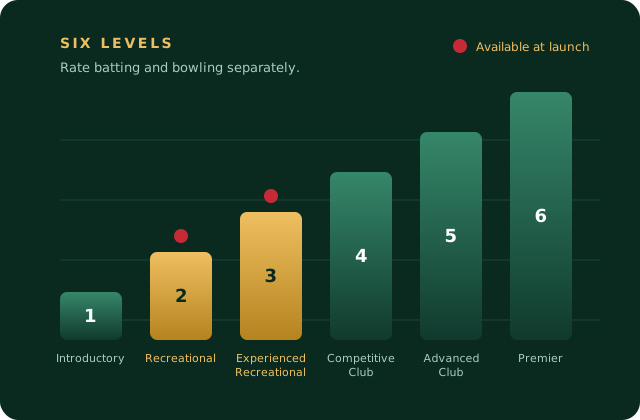
The six SOFF levels

At launch, public match availability is concentrated at Level 2 Recreational and Level 3 Experienced Recreational. More levels may be added after the operating model is proven.

Level 1 — IntroductoryNew to organized leather-ball cricket, or returning after a long absence.

Typical player

New to organized leather-ball cricket, returning after a long absence or moving from casual/tennis-ball cricket into a supervised introductory environment.

Batting indicators

Learning stance, basic shot selection, running between wickets and safe response to moderate bowling.

Bowling indicators

Learning a legal, repeatable action and basic line and length at a safe introductory pace.

Suitable environment

Controlled introductory sessions or specially arranged matches—not automatic placement into every public fixture.
Available at launch

Level 2 — RecreationalPlays mainly for participation, enjoyment and social competition.

Typical player

Has some cricket experience and understands the basic laws but plays mainly for participation, enjoyment and social competition.

Batting indicators

Can defend and score against moderate bowling, although consistency may vary.

Bowling indicators

Can usually complete an over legally and provide a playable challenge, with variable accuracy and pace.

Suitable environment

Recreational leather-ball cricket with balanced opposition and sensible safety controls.

Available at launch

Level 3 — Experienced RecreationalWants meaningful competition without advanced-club intensity.

Typical player

Regular or formerly regular recreational/league participant who wants meaningful competition without advanced-club intensity.

Batting indicators

More reliable technique and scoring options; comfortable against a reasonable range of recreational bowling.

Bowling indicators

Better control, pace or variation; can perform a defined match role with reasonable consistency.

Suitable environment

Strong recreational or intermediate club-style cricket.

Level 4 — Competitive ClubEstablished league or club cricketer in organized, competitive cricket.

Typical player

Established league or club cricketer accustomed to organized, competitive cricket.

Batting indicators

Sound technique, match awareness and ability to handle sustained club-standard pressure.

Bowling indicators

Consistent control, credible pace/spin and a clear wicket-taking or containment role.

Provisional Sri Lankan reference: Selected Division 3-type standards, subject to competition, region and team.

Level 5 — Advanced ClubStrong senior club cricketer performing regularly at a high standard.

Typical player

Strong senior club cricketer who performs regularly at a high standard.

Batting indicators

Advanced technique, adaptability and proven performance against demanding bowling.

Bowling indicators

High control and threat, with the physical and tactical ability to challenge advanced batters.

Provisional Sri Lankan reference: Selected Division 2-type standards, subject to competition, region and team.

Level 6 — PremierPremier, first-class pathway or high-performance cricketer.

Typical player

Premier, first-class pathway, high-performance or equivalent cricketer.

Batting indicators

Capable against high pace, advanced spin and sophisticated plans under sustained pressure.

Bowling indicators

Premier-level pace, spin, control, variation and tactical execution.

Provisional Sri Lankan reference: Selected Division 1/premier-type standards, subject to competition and team.

Important note about Sri Lankan division comparisons

The Division 1, 2 and 3 references are practical calibration aids, not universal equivalencies. Standards can differ among competitions, seasons, regions and teams. SOFF will refine these comparisons using real match evidence.

Rate batting, bowling and keeping separately

A player does not need one overall label. Separate ratings give SOFF a better view of how to balance teams and roles. An example profile:

Batting
Level 3
Bowling
Level 2
Wicketkeeping
Occasional recreational keeper
Video examples

Short clips, not a formal test

Each level will eventually include short, representative clips for:

  • batting against pace;
  • batting against spin;
  • pace bowling;
  • spin bowling; and
  • wicketkeeping where appropriate.

Every clip is published as an example of a level, never as the benchmark a player must match. A single spectacular delivery or shot does not define a standard.

Six rising columns labelled Introductory through Premier, with Levels 2 and 3 marked as available at launch.
If you are unsure

Choose the closest lower level and tell us the rest

Add details in your profile. SOFF may ask for a recent clip, league information or a short discussion before accepting you into a stronger fixture.

Safety and match balance take priority over a requested level. SOFF may recommend a different match or decline a placement that appears unsuitable.